

Last updated on October 6, 2026
If you’ve been recently introduced to the sea moss superfood trend, chances are you’re a bit confused by all the different names people mistakenly use for it.
Sea moss, Irish moss, Jamaican moss, Caribbean moss, Carrageenan moss: What’s the difference? Are they all the same seaweed? Why do we use different names?
Unfortunately, the answers aren’t that simple, and there’s definitely a need to bring some clarifications and finally get things straight. You have the right to know what you’re buying. And, as a sea moss company, we owe you detailed, reliable, and accurate information.
Simply put, “sea moss” is a broader common name. Irish moss usually means Chondrus crispus, while Caribbean sea moss includes other red seaweeds, such as Eucheuma cottonii and Gracilaria. Our Saint Lucian raw sea moss and gel use Eucheuma cottonii; our capsules, collagen powders, and gummies use Chondrus crispus. So these names help you get to know the sea moss you’re choosing!
However, sea moss’s species, growing environment, season, and preparation may affect its nutrient composition. And that’s where the difference is relevant because those natural nutrients are part of what makes sea moss such an appealing addition to your wellness routine.
So, let's browse the similarities and differences between Irish, Caribbean, Jamaican, and other sea mosses. And most importantly, does it really matter?
Related article: What are sea moss benefits for health?

Where Does Sea Moss Come From?
Irish moss is scientifically known as Chondrus crispus. This edible seaweed belongs to the Rhodophyta division (red algae), the Florideophyceae class, the Gigartinales order, and the Gigartinaceae family. “Sea moss” is a common name that can also be used for other red seaweeds, so geography alone does not identify the species.
Related article: How is sea moss different from other seaweeds?
Sea moss: the broader name
Sea moss is a common name used for several red seaweeds. Irish moss is one familiar example, while “Jamaican moss” or “Caribbean moss” may describe the origin or the local food tradition. A scientific name gives you a more precise identification.
Sea moss has been used in traditional foods, medicine, and beauty routines for generations. It is celebrated for its familiar “92 of 102 minerals” profile; our guide explores the nutrient minerals and other elements behind that description. This variety makes it a popular superfood. Our related guides explore heart health, diabetes and blood-sugar questions, weight management, nutrition for normal immune function, fertility and nutrition, and skin care.
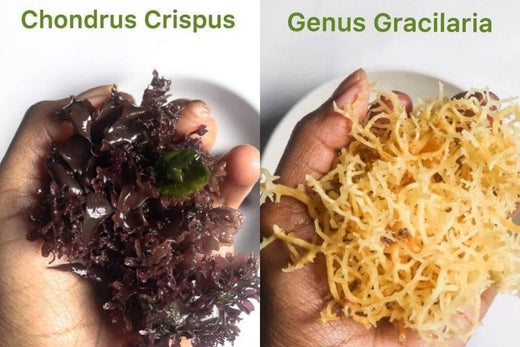
Natural, wildcrafted sea moss can have branching, tangled, or fan-shaped fronds, depending on the species. Irish moss often has flatter, fan-like branches, while some Caribbean varieties have more slender branching forms. Appearance is one clue, alongside sourcing and species information.
Sea moss has various shades and colors, including brown, yellow, gold, purple, red, green, pink, or very dark tones. Natural pigments, light conditions, and drying help shape that appearance. Those beautiful colors are part of its natural variety, and different colors can occur within the same species. Species, growing conditions, and preparation give you a fuller picture of its composition.
Related article: The differences between purple, gold, and green sea moss
Irish moss
Irish moss (Chondrus crispus) is naturally found along the northern Atlantic coasts of Ireland and New England, hence its name. It's also commonly referred to as "Irish sea moss." Irish moss grows abundantly on the west coast of Ireland, specifically around the Aran Islands and the Connemara coast.
Irish moss has been used in traditional Irish medicine for centuries, especially as a natural remedy for flu-like viruses, to make cough syrup, combat mucus, treat respiratory conditions, and reinforce the immune system. It was also an essential source of nutrition for the Irish people during the Great Famine in the mid-19th century.
Caribbean and Jamaican moss
Sea moss also grows in abundance in the Caribbean region, where it’s commonly called Caribbean moss or Jamaican moss.
Caribbean sea moss includes red seaweeds such as Eucheuma cottonii and Gracilaria. The FAO’s account of West Indian seaweed cultivation describes both Gracilaria and Eucheuma. Species and growing conditions influence composition, helping explain the variety of textures and nutrients found in these tropical seaweeds.
The Caribbean has its own rich sea moss food traditions. The Jamaicans traditionally boil it in milk and mix it with spices to make Jamaican moss drink. This health concoction is primarily used as an aphrodisiac sex elixir to boost men’s libido and a beauty product for skin and hair.
Saint Lucia sea moss
Saint Lucia sea moss is sea moss harvested in Saint Lucia, an island country located in the Caribbean Sea.
Saint Lucia sea moss is renowned worldwide for its superior quality. It grows in pristine waters, exceptionally rich in minerals.
At Organics Nature, we harvest wildcrafted sea moss in Saint Lucia in collaboration with the Agriculture Department to ensure we minimize our impact on the local ecosystem.

Carrageen moss
Carrageen moss is another name for sea moss. It’s a reference to Chondrus crispus and its carrageenan, a gel-forming polysaccharide in the seaweed’s cell walls that can be extracted for food use.
Carrageenan is mainly used as a thickener and emulsifier in the food industry.
Related article: 10 tasty sea moss recipes to try today!
Irish Moss vs. Sea Moss
As mentioned above, Irish moss is one type of sea moss: Chondrus crispus. Sea moss is the broader name, while Jamaican or Caribbean labels often refer to the place or tradition. So what differences matter when choosing your sea moss? Look at its identity, sourcing, preparation, and how you want to use it.
Is Irish moss the same as sea moss?
Botanically speaking, Chondrus crispus is a particular species. It has its own composition and gel-forming properties, while other sea moss varieties offer their own textures and uses. Understanding both the common and scientific names helps make the choices clearer.
As we have shared in previous blogs, collagen is a structural protein, especially important in connective tissues such as skin. Sea moss supplies plant-based nutrients, while collagen comes from animal connective tissue. A varied diet with enough protein and vitamin C helps normal collagen formation. Our collagen-and-sea-moss powder brings marine collagen peptides and Irish moss (Chondrus crispus) together in a convenient Vanilla-Caramel drink. It’s an easy way to enjoy both ingredients in your daily routine!

Another fascinating feature of red seaweeds is their pigment variety. Phycoerythrin, phycocyanin, chlorophyll, and carotenoids contribute to their appearance. Some seaweeds also have microscopic structures that reflect vivid colors. Together, these features help explain the lovely range of colors you’ll see in Irish and Caribbean sea moss.
Growing conditions, species, and processing can affect seaweed compounds. This is part of the appeal of learning about where your sea moss comes from! Our Saint Lucian wildcrafted sea moss offers natural ocean-grown character, careful harvesting, and sun drying.
Seaweed compounds have shown antioxidant activity in laboratory research, which is one reason scientists are interested in their potential roles in inflammation, heart health, diabetes, and cancer research. These studies explore particular compounds and preparations; in your kitchen, sea moss brings its own texture and natural ingredient variety to a balanced diet. Enjoy it as a food alongside the care that suits your health needs.
For comparison, anthocyanins are familiar pigments in foods such as purple cabbage, eggplant, and berries. Seaweeds have their own pigment chemistry, giving us another reason to appreciate variety in a colorful diet!
Irish vs. Caribbean: which is better?
Irish moss has long been seen as a superior sea moss, but it’s not necessarily true. Caribbean sea moss from Saint Lucia has gained increased popularity lately. We love our Saint Lucian wildcrafted sea moss for its mineral-rich ocean origin, purity-focused handling, and gentle sun drying. Those qualities are at the heart of the natural sea moss experience we want to share with you!
Ultimately, names alone do not tell the whole story. Irish and Caribbean sea mosses share an edible-red-seaweed tradition, while their species, textures, and composition can differ. For a product you’ll enjoy, choose clear sourcing, careful preparation, and a format that fits your daily routine.
Choose quality wildcrafted sea moss
The most important thing is to know what you’re purchasing and choose the sourcing and preparation you want. At Organics Nature, we favor wildcrafted sea moss from Saint Lucia, hand-harvested and sun-dried, with third-party testing for purity and heavy metals.
Sea moss can be cultivated as well as wildcrafted, and its quality depends on the species, water, growing methods, and handling. Our Saint Lucian raw sea moss and gel celebrate natural ocean-grown sourcing and careful preparation: hand harvesting, sun drying, and third-party testing for purity and heavy metals. That attention to the ingredient gives you plenty of reasons to choose Organics Nature with confidence.
Related article: How to compare cultivated and wildcrafted sea moss?
Chondrus crispus vs. Gracilaria
Finally, let's close the topic with a common mistake you often encounter when reading about the differences between Irish moss and sea moss online.
Everyone wants a say in the new sea moss trend, but not everyone is a qualified scientist or botanist. Actually, most self-proclaimed online sea moss experts lack basic knowledge about seaweeds.
A widespread confusion is about Chondrus crispus and the genus Gracilaria. One is a species name and the other is a genus containing multiple species. They are distinct seaweeds, and both names can come up when people talk about sea moss.
While they belong to the same division (Rhodophyta) and class (Florideophyceae), they do not belong to the same order. Gracilaria is a gracilariales seaweed, while Chondrus crispus (sea moss) is a gigartinales one. Although they may look alike and share some characteristics, Gracilaria is a genus whose species are also sold as sea moss in the Caribbean.
Organics Nature offers carefully sourced sea moss in several convenient formats, including Saint Lucian wildcrafted raw sea moss and gel made with Eucheuma cottonii, plus capsules, collagen powders, and gummies made with Irish moss (Chondrus crispus). Our capsules also include bladderwrack and burdock root. Whether you love making your own gel, enjoying a fruity spoonful, or keeping things convenient, there’s a format for your routine! Follow your chosen product’s directions and enjoy our 30-day money-back guarantee.

We hope this article has shed some light on what sea moss is and what it is not. Please, do not hesitate to reach out in the comment section below if you have any doubts or questions!